Last updated:
After a dog bite, one question can decide your whole claim: was the dog provoked? In most states, a provoked dog bite can reduce or even eliminate the owner’s liability, while an unprovoked dog bite usually makes your claim much stronger. This guide explains the difference, how each state treats it, and what evidence protects you.
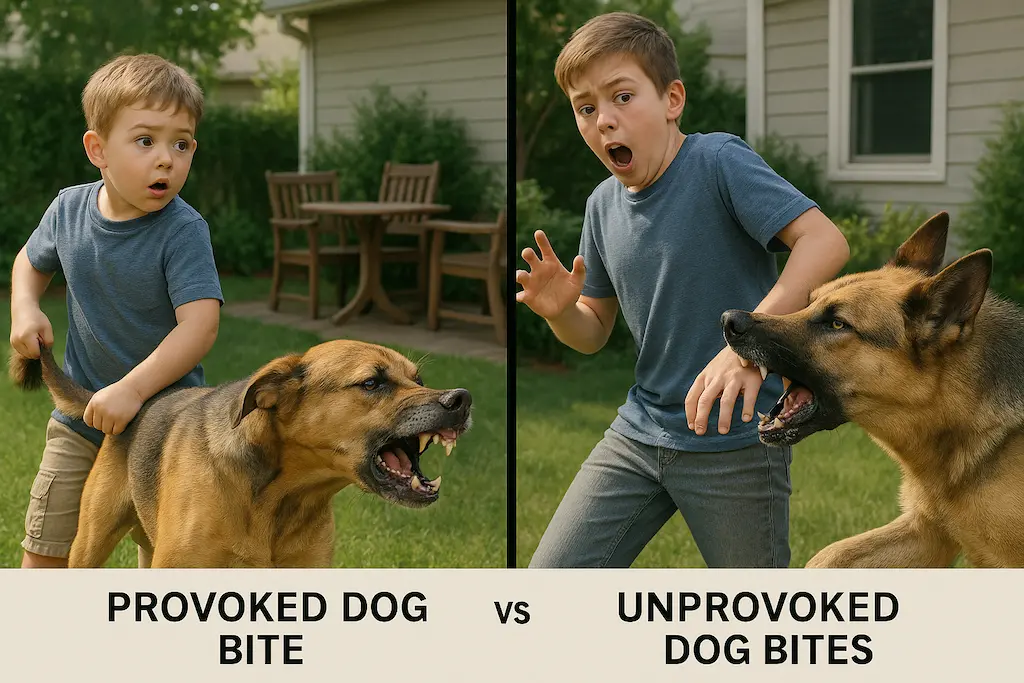
Provoked vs. Unprovoked Dog Bites: The Difference
🔴 Provoked Bite
The victim’s behavior triggered the attack: hitting or teasing the dog, pulling its tail, stepping on it, reaching for its food or puppies, or entering its space suddenly. Even unintentional acts can count as provocation in some states.
🟢 Unprovoked Bite
The victim did nothing to trigger the attack: walking down the street, jogging, delivering a package, or visiting a park at a normal distance from the dog. These cases usually make owner liability easier to establish.
What Counts as Provocation?
Courts usually ask whether the victim’s action would have caused a typical dog to react aggressively. Common examples include:
Physical Harm
Hitting, kicking, or throwing objects at the dog.
Teasing or Threatening
Yelling, taunting, cornering the dog, or making threatening gestures.
Sudden Space Invasion
Reaching for the dog’s food, toys, or puppies, or grabbing it unexpectedly.
Accidental Harm
Stepping on the dog’s paw or tail, or tripping over it, even without meaning to.
Not every interaction is provocation. Petting a calm dog in a friendly way, for example, would rarely be considered provocation.
How Provocation Affects Your Claim in Each State
The impact of provocation depends on your state’s dog bite law and on its rules about shared fault.
1. Strict liability states
In these states the owner can be liable even if the dog never bit anyone before. Provocation is the main defense. Who has to prove it depends on the state: in Illinois, for example, the Animal Control Act protects people injured “without provocation”, so the victim must show the dog was not provoked.
2. One-bite rule and negligence states
Here the victim usually has to show that the owner knew, or should have known, the dog was dangerous, or that the owner was careless. Evidence of provocation makes these claims harder to win.
3. Rules on shared fault
If you were partly at fault, for example because you accidentally provoked the dog, your state’s fault rule decides what you can still recover:
Example: with $100,000 in damages and 30% of the fault, a victim in a comparative fault state would typically recover about $70,000. In a contributory negligence state, the same victim could recover nothing on a negligence claim.
📊 How Much Is Your Case Worth?
Use our Dog Bite Settlement Calculator to estimate your compensation based on medical costs, lost wages, and shared fault.
Evidence That Shows the Bite Was Unprovoked
1. Medical Records
Get treatment right away. ER reports, doctor notes, and photos of your wounds document the injury and its severity.
2. Witnesses
Collect names and contact details of anyone who saw what you were doing before the bite.
3. Photos and Video
Photograph your injuries and the location. Ask nearby homes or businesses for security footage quickly: it may be deleted within weeks.
4. Official Reports
Report the bite to animal control or the police, and ask whether the dog has prior bite reports.
FAQ: Provoked vs. Unprovoked Dog Bites
What counts as provoking a dog?
Any act that would reasonably make a typical dog bite, even if accidental.
Hitting, teasing, cornering the dog, reaching for its food, or stepping on its paw can all count. Courts look at what a normal dog would do in the same situation, not only at the victim’s intent.
Can I get compensation if I accidentally provoked the dog?
In most states yes, but your payout may be reduced.
Comparative fault states reduce your compensation by your share of fault, and some bar recovery above 50%. In Alabama, Maryland, North Carolina, Virginia, and Washington, D.C., even a small share of fault can bar a negligence claim.
Who has to prove the bite was provoked?
It depends on the state.
In some states the owner raises provocation as a defense. In others, such as Illinois, the victim must show the dog was not provoked. Either way, witnesses, photos, and official reports are your best protection.
Does an unprovoked bite guarantee compensation?
No, but it makes your claim much stronger.
You still need to meet your state’s legal requirements, such as proving the owner knew the dog was dangerous in one-bite states, and you must file within your state’s deadline, which ranges from 1 to 6 years.
How do I estimate what my dog bite case is worth?
Start with your medical costs and lost wages, then adjust for pain and suffering.
Our Dog Bite Settlement Calculator gives an educational estimate. A licensed attorney in your state can give you an accurate evaluation.
Sources: Illinois Animal Control Act, 510 ILCS 5/16; Florida HB 837 (2023); state comparative and contributory negligence rules.